
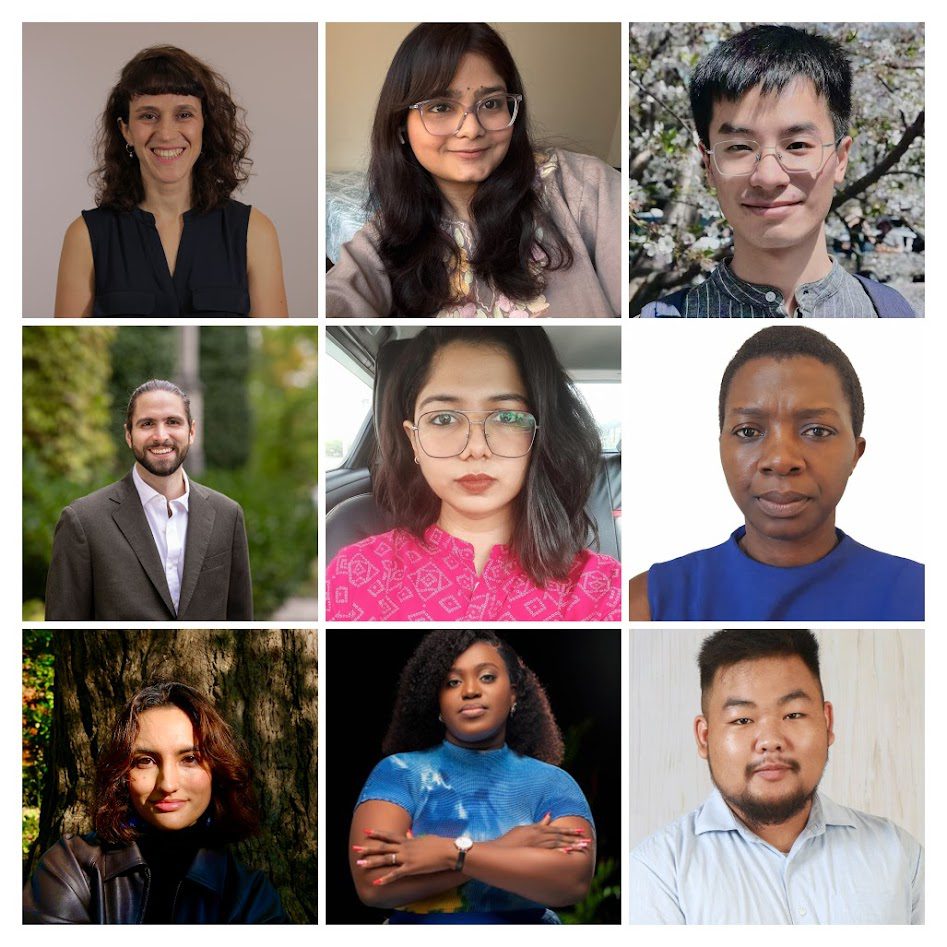
We are pleased to announce the inaugural cohort of recipients of the JHU CGP’s small grants on “Mechanisms of Poverty: Qualitative Studies to Solve Global Poverty.” The recipients will present their research during the 2026-27 academic year. Please see https://sites.krieger.jhu.edu/cgp/events/
Milena Arancibia
CONICET
Fieldsite: Buenos Aires, Argentina
Milena Arancibia works as a researcher for the National Scientific and Technical Research Council of Argentina (CONICET) at the Institute of Latin American and Caribbean Studies, University of Buenos Aires. Her research examines how cooperatives and social enterprises contribute to poverty reduction and social inclusion among young, low-income women and trans, travesti, and non-binary individuals in marginalized neighborhoods of Buenos Aires, Argentina. Through interviews, focus groups, and participatory workshops, the project explores these organizations’ role in expanding access to income, skills, social networks, and community well-being. The participatory approach also supports the co-production of knowledge and helps identify locally grounded strategies to strengthen collective organizations.
Sebastián Rojas Cabal and María Ximena Dávila Contreras
Princeton University and University of Texas, Austin
Fieldsite: Bogotá, Colombia
Sebastián Rojas Cabal and María Ximena Dávila are Colombian Sociology Ph.D. candidates—Sebastián at Princeton University and María Ximena at the University of Texas at Austin. Their project is based on over 100 in-depth life history interviews with internally displaced adults across strategically selected neighborhoods in Bogotá, tracing trajectories of social mobility and stagnation and identifying the conditions that enable or hinder socioeconomic advancement in post-conflict urban settings. The project also draws on complementary interviews with frontline bureaucrats to understand how displacement policies are interpreted and delivered at the street level. These data allow them to reconstruct the complete policy chain—from rules to implementation to lived experience—and to pinpoint where and how policies miss their target.
Ziyang Cai
University of Virginia
Fieldsite: Southwest China
Ziyang Cai is a PhD student in Sociology at the University of Virginia. His project evaluates the efficacy of tourism-centered development strategies as countermeasures to the deindustrialization process in Southwest China. In his cases, industrialization projects in the Cold War era were first abandoned and neglected after the 1980s; then attempts have been made since the 2010s to transform them from a difficult past into profitable industrial heritage. Through a combination of archival work, in-depth interviews, and participant observation, he traces the interaction between the entrepreneurial local state and local communities in the making of memories, in order to see what makes the investment possible and how symbolic and material benefits are distributed among different actors. This research aims to empower local communities to navigate and remake these projects, while providing institutional advice that makes such transitions socially inclusive and economically sustainable.
Anjali Chauhan
University of Delhi
Fieldsite: Delhi NCR, India
Anjali Chauhan is a feminist researcher and writer working on gender, labor, and political economy in the Global South. Her project examines how workplace sexual harassment and structural economic precarity at the urban margines reinforce and reproduce one another among migrant women garment workers in Delhi NCR. Grounded in ethnographic research, it analyzes the informal strategies women use to navigate workplace vulnerabilities and violence and develops intervention-oriented insights rooted in these lived experiences. By foregrounding workplace relations as a central mechanism through which poverty is actively reproduced, the study seeks to generate actionable guidance for anti-poverty policy and labor governance.
Nazreen Fatima
Johns Hopkins University
Fieldsite: Persian Gulf
Nazreen Fatima is a graduate student at the Department of Sociology at Johns Hopkins University. Her research project examines how transnational migration can be harnessed as shared security to fight against global poverty. While labor migration raises household incomes, its collective transformative potential is often lost without “institutional infrastructures” to convert private earnings into public goods. Through a comparative study of Muslim Gulf migrants from India, the research contrasts the experience of Kerala, where the Kerala Muslim Cultural Centre (KMCC) functions as a faith-based “informal welfare state” providing healthcare/ subsidized housing and pensions, with the marginalized, under-networked Muslim communities of West Bengal. Moving beyond passive observation, the project employs a “collaborative ethnographic approach” to facilitate mentorship between these diasporas, testing whether Kerala’s model of subnational solidarity can serve as a “replicable template” for turning individual mobility into collective security for other regions.
Thangsiandong Guite
Indian Institute of Science Education and Research (IISER), Mohali
Fieldsite: Northeast India
Thangsiandong Guite is a PhD research scholar in the Department of Humanities and Social Sciences (DHSS) at the Indian Institute of Science Education and Research (IISER), Mohali. His project begins from a question: what role do informal actors play in mitigating poverty? The project identifies and analyses the causal mechanisms through which community-based institutions, particularly the civil society organisations (CSOs) and faith-based organisations (FBOs), function as informal systems of social insurance. The project evaluates both the strengths and structural limitations of communitarian arrangements. Adopting a problem-solving approach, it seeks to explore how formal state welfare mechanisms can be integrated with communitarian Mizo institutions to more effectively reduce poverty and vulnerability. In doing so, it also challenges the prevailing tendency to treat community-based institutions as residual or merely cultural phenomena.
Clara Lemani
Partners in Hope
Fieldsite: Lilongwe, Malawi
Clara Lemani is a social scientist from Malawi with expertise in research studies implementation, data management, and monitoring and evaluation of public health programs. She holds a master of philosophy (MPhil) degree in Demography from the University of Cape Town in South Africa. Clara’s project will examine ways to optimize Malawi’s Social Cash Transfer Programme (SCTP) to better support teenage mothers in Lilongwe’s informal settlements, aiming to break the cycle of intergenerational poverty.
Glory Mzama
Kamuzu University of Health Sciences (KUHeS) Blantyre, Malawi
Fieldsite: South Africa
Glory Mzama is a Malawian Public health researcher currently based in South Africa trained in Epidemiology and Implementation Science, with a strong interest in community-led solutions to poverty and vulnerability. Her project explores how Malawian migrant women in South Africa use village banks (village savings and loan associations [VSLAs]) as practical tools to manage financial insecurity in contexts of unstable income and limited access to formal financial services. Using qualitative methods, her research focuses on the mechanisms that make these grassroots initiatives effective, with the aim of generating problem-solving insights for poverty reduction among migrant and informal populations.