
“All we have discovered is that it starts with a single individual – always a child – and then spreads explosively, like the formation of crystals round the first nucleus in a saturated solution.” Arthur C. Clarke (Childhood’s End, 1953)
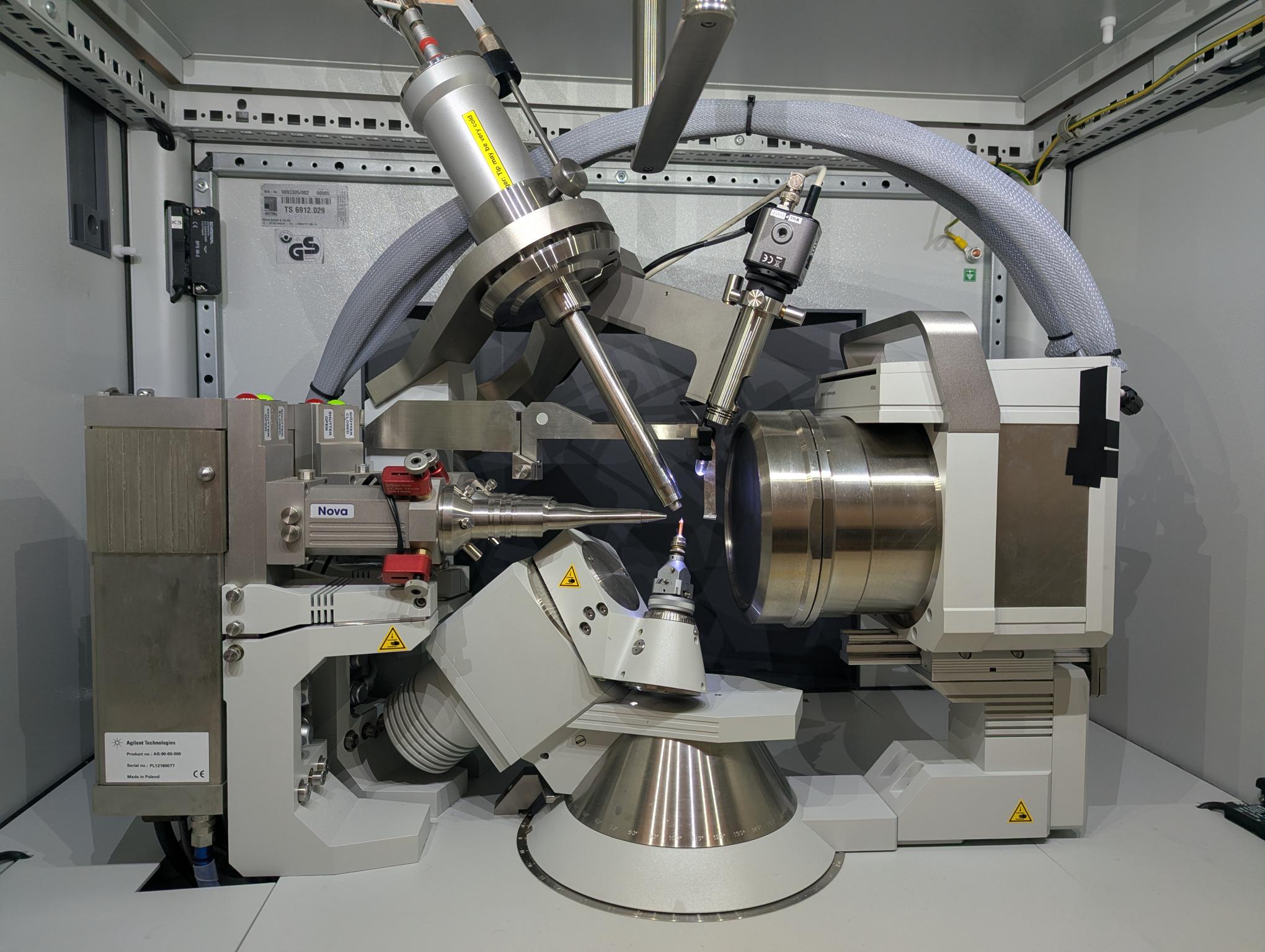 SuperNova diffractometer: a compact dual-source system (Mo and Cu) for versatile data collection. |
The Rigaku SuperNova Dual-Wavelength (Mo/Cu) is a versatile single-crystal X-ray diffractometer designed to deliver high-quality structural data across a broad range of applications. Its dual-source configuration allows seamless switching between molybdenum (Mo Kα) and copper (Cu Kα) radiation, enabling users to select the optimal wavelength for each sample and enhancing data quality, resolution, and refinement outcomes while maximizing experimental flexibility. The system is equipped with a CCD Atlas detector that offers a large active area for efficient data capture, ensuring reliable and consistent results for both routine analyses and advanced crystallographic studies. The SuperNova system is also equipped with an Oxford Instruments Cryojet XL, enabling precise temperature control for variable-temperature data collection (temperature range: ≈90-300 K)and low-temperature crystallographic experiments.
If you are working with very challenging crystals, you may want to maximize the capabilities of single-crystal X-ray analysis using the Rigaku XtaLAB Synergy-R equipped with a Cu rotating anode. Please contact the X-ray facility manager to discuss your samples, request example datasets, or arrange a demonstration and trial with your own crystals. We will work with you to determine the most effective data-collection strategy and the outcomes you can expect.
Dual-Wavelength Advantage
The SuperNova provides true two-source capability within a single, compact instrument.
- Mo Kα radiation offers excellent penetration, making it ideal for routine small-molecule structure determination, metal-containing complexes, and samples with moderate absorption.
- Cu Kα radiation, with its higher anomalous scattering power, enhances contrast for light-element structures, organic systems, chiral determination, and very small or weakly diffracting crystals.
The ability to switch rapidly between sources allows researchers to fine-tune data collection strategies based on experimental requirements without changing instruments or detectors.
Key Features
- True dual-wavelength capability: Independent Mo and Cu sealed-tube sources (50 W) for maximum experimental flexibility.
- CCD Atlas detector: Large active area for efficient and stable data capture.
- Compact system footprint: High performance in a space-efficient laboratory format.
- Precision goniometry: Accurate, stable sample positioning for high-quality measurements.
- Integrated software workflow: CrysAlisPro enables experiment setup, acquisition, reduction, and export in a single platform.
- Reliable data across sample types: Supports inorganic complexes, organometallics, small molecules, pharmaceuticals, chiral compounds, and more challenging crystals.
- Ideal for both teaching and research laboratories: Easy to operate, maintain, and integrate into multi-user environments.