
“All we have discovered is that it starts with a single individual – always a child – and then spreads explosively, like the formation of crystals round the first nucleus in a saturated solution.” Arthur C. Clarke (Childhood’s End, 1953)
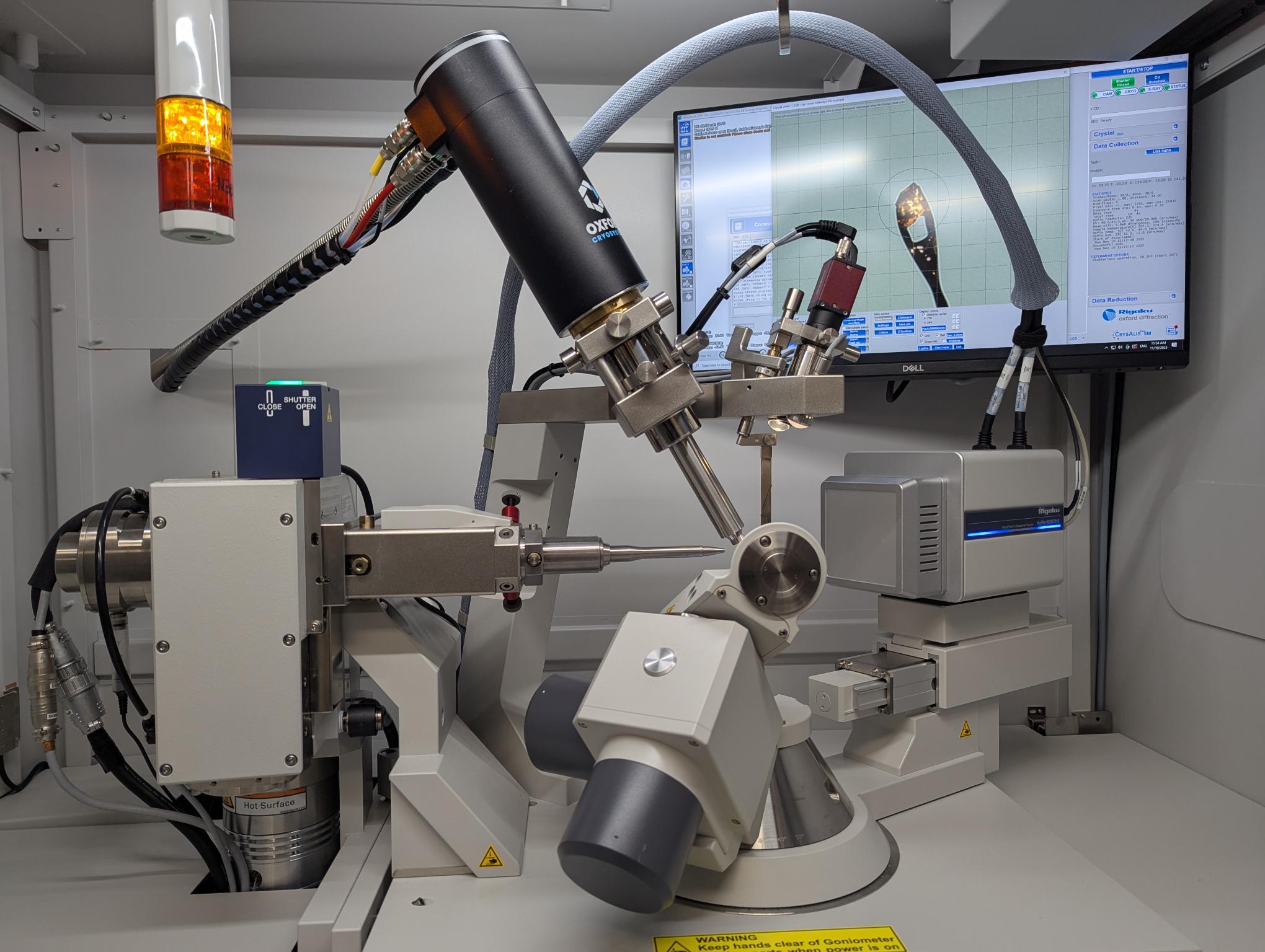 XtaLAB Synergy-R built around the PhotonJet-R rotating anode X-ray source (Cu) |
The Rigaku XtaLab Synergy-R is a high-flux rotating-anode single-crystal X-ray diffractometer that combines speed, sensitivity, and reliability for advanced crystallographic research. Configured with a Cu Kα radiation source, it delivers an intense, stable X-ray beam ideally suited for challenging small-molecule and macromolecular samples. This configuration enhances anomalous scattering, improves contrast for lighter elements, and enables the collection of high-quality data from microcrystals that are otherwise difficult to measure. The microfocus Cu rotating-anode used in the Synergy-R (PhotonJet-R / MicroMax-007 HF) runs at 1.2 kW (1200 W). This system can produce up to 30× the flux compared compared with the microfocus Cu sealed-tube source from the SuperNova system.
If you are working with challenging crystals or need to maximize the capabilities of single-crystal X-ray analysis, the Rigaku XtaLAB Synergy-R equipped with a Cu rotating anode offers a significant performance advantage. Contact the X-ray facility manager to discuss your samples, request example datasets, or arrange a demonstration and trial with your own crystals. We will work with you to determine the most effective data-collection strategy and the outcomes you can expect.
The instrument is particularly valuable for the following types of samples:
- Tiny crystals – Samples with crystal dimensions of ~ 10–40 μm. The Synergy-R’s powerful Cu source allows accurate and complete data collection from such small samples.
- Weakly diffracting or complex materials – Structures that exhibit poor long-range order or contain substantial solvent inclusion (e.g., metal–organic frameworks and supramolecular assemblies) often produce weak diffraction. The Synergy-R significantly improves data resolution and quality, enabling reliable structure determination suitable for publication.
- Protein crystals with long unit-cell dimensions – Protein crystals with extended unit cells (~ 150 Å or longer) exceed the capabilities of our existing SuperNova system, limited by its fixed beam divergence (4.5 mrad) and lower flux. The Synergy-R’s high-intensity source and optimized optics overcome these constraints, facilitating complete and precise data collection for such systems.
Key Benefits
• Exceptional sensitivity for micro-crystals: Obtain usable diffraction from crystals that would be invisible on lower-power instruments.
• Improved anomalous signal: Cu Kα wavelength enhances anomalous scattering for many light-to-medium elements, aiding absolute configuration and element identification.
• Faster collections, higher throughput: Greater photon flux supports both reduced exposure times and enhanced data redundancy, all without compromising data quality.
• Robust, reproducible results: Stable beam and modern detector technologies ensure consistent datasets suitable for publication and deposit.
• Versatile sample compatibility: inorganics,* organics, organometallics, coordination complexes, supramolecular complex, protein crystals and weakly diffracting materials.
* Crystals should be very small—ideally 10–20 µm in each dimension—to reduce absorption effects. Using the Synergy-R Cu configuration, a maximum resolution of approximately 0.79 Å can be achieved.
Technical Highlights
• Cu rotating-anode X-ray source: high-power (1.2 kW), stable Cu Kα radiation (λ ≈ 1.5418 Å) optimized for anomalous studies and contrast of light elements.
• Advanced hybrid photon-counting detector HyPix-6000HE for fast readout, low noise and high dynamic range.
• Integrated low-temperature cryo-device Oxford Cryostream 1000 for temperature-dependent studies (temperature range: 80-400 K) and radiation-damage mitigation.
• Integrated into the variable-beam optics, the slit mechanism regulates the beam width, shape, and divergence, giving users fine control to match the beam to the sample and experiment.
• CrysAlisPro offers automated experiment planning, real-time data processing (single, twinning, mult-crystal), advanced absorption corrections, and seamless export to all major refinement packages.